CareLoop — Caregiver Onboarding & Verification
CareLoop — Caregiver Onboarding & Verification
CareLoop is a multi-sided home healthcare platform connecting caregivers, families, and care operations. This case study focuses on the Caregiver Onboarding & Verification flow, designed to establish trust, prevent credential misrepresentation, and scale safely within a regulated healthcare environment.
Year
2026
Client
CareLoop
Service
UX/UI Design
Role
Lead UX/UI Designer
01
Project Goals
Prevent Credential Misrepresentation in Caregiver Profiles
Objective: Ensure regulated healthcare roles cannot be claimed without verified certification while preserving flexibility for non-clinical caregivers.
Success Metric: Eliminate unverified use of protected titles such as CNA, RN, and LPN across caregiver profiles.
Sub-Goals:
Restrict regulated job titles to verified certifications only.
Block manual entry of protected titles during work experience entry.
Clearly distinguish verified credentials from self-reported experience.
Visually reinforce credential trust through profile badges and labels.
Create a Clear Separation Between Certifications, Experience, and Skills
Objective: Establish a structured data model that accurately reflects caregiver qualifications without conflating credentials and experience.
Success Metric: Reduce caregiver confusion and admin corrections related to profile accuracy.
Sub-Goals:
Separate certifications emphasize verified, review-based workflows.
Treat work experience as self-reported but governed by credential rules.
Allow skills to be freely selected for matching without credential claims.
Communicate differences clearly through field labels and helper text.
Design a Transparent and Trust-Building Verification Experience
Objective: Make credential verification feel understandable, fair, and purposeful rather than punitive or opaque.
Success Metric: Maintain high caregiver onboarding completion rates during verification steps.
Sub-Goals:
Clearly communicate why verification is required for certain roles.
Surface real-time status states such as “Under Review” and “Approved.”
Provide actionable feedback when documentation is missing or rejected.
Reinforce progress and next steps throughout the onboarding flow.
Support Both Clinical and Non-Clinical Caregivers
Objective: Enable certified and non-certified caregivers to onboard successfully without unnecessary barriers.
Success Metric: Increase overall caregiver onboarding completion while supporting diverse caregiver backgrounds.
Sub-Goals:
Allow non-certified caregivers to bypass certification steps.
Ensure marketplace visibility does not require credentials unless necessary.
Highlight skills and experience appropriately for non-clinical roles.
Avoid positioning certification as a prerequisite for participation.
Enable Scalable Admin Review and Enforcement
Objective: Provide operations teams with efficient tools to review, approve, and enforce credential accuracy at scale.
Success Metric: Reduce manual review time per caregiver profile.
Sub-Goals:
Create centralized admin review queues for certification submissions.
Automatically flag suspicious work experience entries.
Enable one-click approval, rejection, and escalation actions.
Maintain audit-friendly records of verification decisions.
Maintain a Low-Friction Onboarding Experience
Objective: Balance healthcare compliance requirements with a fast, approachable onboarding flow.
Success Metric: Minimize caregiver drop-off during onboarding without compromising trust or safety.
Sub-Goals:
Break onboarding into clear, digestible steps.
Allow progress to be saved and resumed at any time.
Use inline validation instead of blocking errors.
Reinforce momentum through confirmation and success states.
02
Research and Discovery
The design process began with focused research to understand how caregivers onboard onto healthcare platforms, how credentials are verified, and where misrepresentation and friction most often occur. The goal was to identify trust gaps, operational risks, and opportunities to design a verification system that scales without compromising user experience.
Competitive Analysis
I evaluated platforms across adjacent healthcare and marketplace categories to understand how credentials, job titles, and experience are handled.
Healthcare Staffing Platforms:
Many platforms rely heavily on document uploads and manual review but provide limited transparency to caregivers during the verification process. Credential status is often hidden or unclear, leading to confusion and drop-off.
Caregiver Marketplaces:
Most consumer-focused caregiving platforms allow broad self-reporting of job titles and experience, increasing the risk of credential misuse and reducing trust for families.
Hybrid Marketplaces:
Platforms supporting multiple roles frequently separate caregiver and admin experiences into different dashboards or accounts, creating operational complexity and context switching.
Key User Types
Certified caregivers (CNA, RN, LPN) requiring license verification
Non-clinical caregivers relying on experience and skills
Families making high-trust hiring decisions
Admin and operations teams responsible for review and enforcement
A key challenge was designing a system that supports overlap, as caregivers may transition between roles or gain certifications over time.
User Interviews and Stakeholder Input
Insights were gathered through internal stakeholder discussions, design reviews, and analysis of common pain points reported in caregiver onboarding flows.
Key findings included:
Regulated credentials such as CNA, RN, and LPN must be verified rather than self-reported
Job titles are ambiguous and frequently misused as proxies for certification
Skills are valuable for caregiver matching but do not require verification
Caregivers want clarity around why verification is required and how long it takes
Admin teams need efficient ways to flag and review suspicious profile entries
Competitive Patterns Observed
Credential gating used to restrict access to regulated roles
Badge-based systems to visually indicate verified status
Manual review queues for edge cases and escalation
Clear separation between verified credentials and self-reported data
Journey Mapping
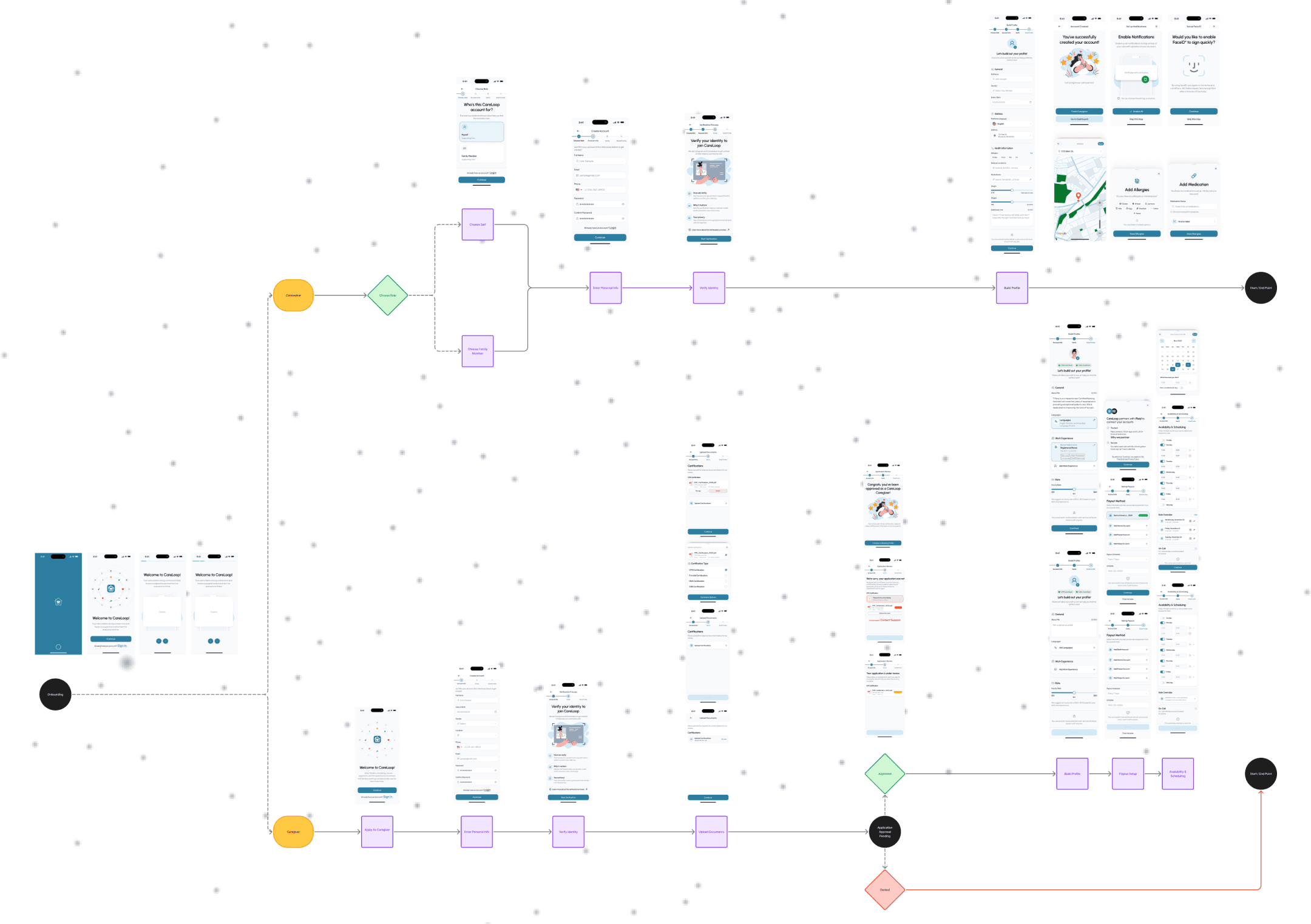
I mapped the end-to-end caregiver onboarding journey, from account creation through profile approval, to identify friction points and decision moments.
Key findings included:
Creating an account and selecting caregiver role
Submitting certifications for verification
Building a caregiver profile while under review
Entering work experience without misrepresenting credentials
Admin review, approval, and profile activation
This process surfaced critical drop-off risks during verification and profile completion, directly informing the decision to introduce credential gating, transparent status states, and clear data separation.
03
Key Findings
Trust is earned through clarity, not restriction:
Caregivers are willing to verify credentials when the reason is clear and the process feels fair. Opaque review states or silent rejections quickly erode trust.
Credentials must be treated as regulated data, not free text:
Allowing caregivers to self-report regulated titles creates risk and undermines platform credibility. Certification needs to live in a controlled, verified system separate from experience and skills.
Job titles are not reliable indicators of qualification:
Work experience alone cannot validate clinical capability. Without guardrails, job titles become proxies for credentials and lead to misrepresentation.
Verification should guide users forward, not block them:
Hard stops increase drop-off. Inline validation, clear status messaging, and visible next steps maintain momentum while still enforcing compliance.
One caregiver, evolving qualifications:
Caregivers may start as non-clinical and later gain certifications. The system must support growth over time without forcing re-onboarding or profile resets.
04
Wireframing and Prototyping
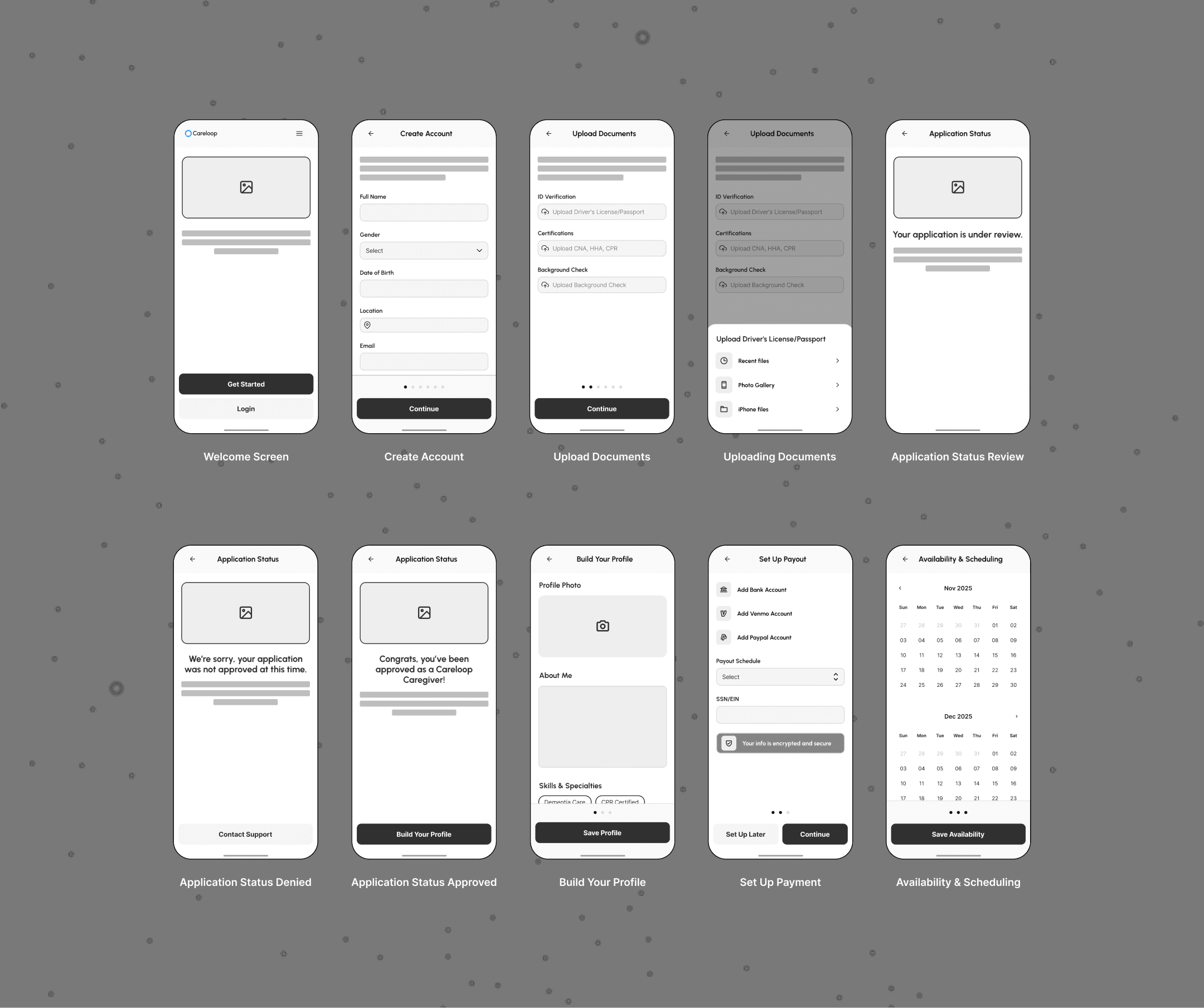
Lo-Fi Sketches (Paper and Figma):
Mapped the end-to-end caregiver onboarding journey from account creation through verification and profile readiness.
Explored different step-based onboarding models to balance regulatory requirements with caregiver motivation and momentum.
Sketched document upload, certification review, and status feedback patterns that clearly communicate progress without overwhelming users.
Tested early role-definition concepts to separate job title, certifications, and skills without conflating trust signals.
Focused on clarity-first layouts to prevent caregivers from misrepresenting qualifications during early profile setup.
Mid-Fi Figma Prototypes:
Built clickable onboarding flows for:
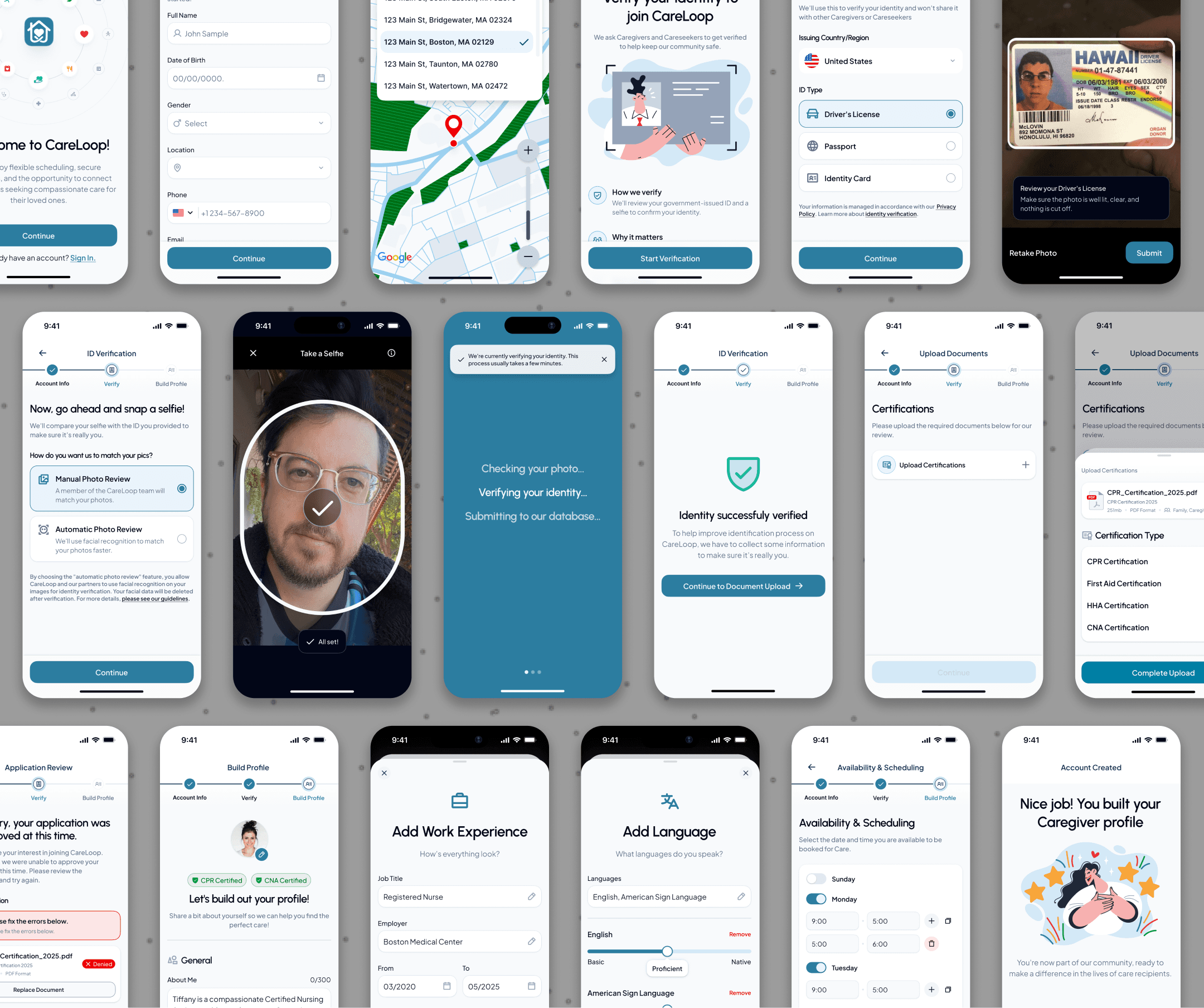
Sign Up → Identity Verification
Certification Upload → Admin Review → Approval State
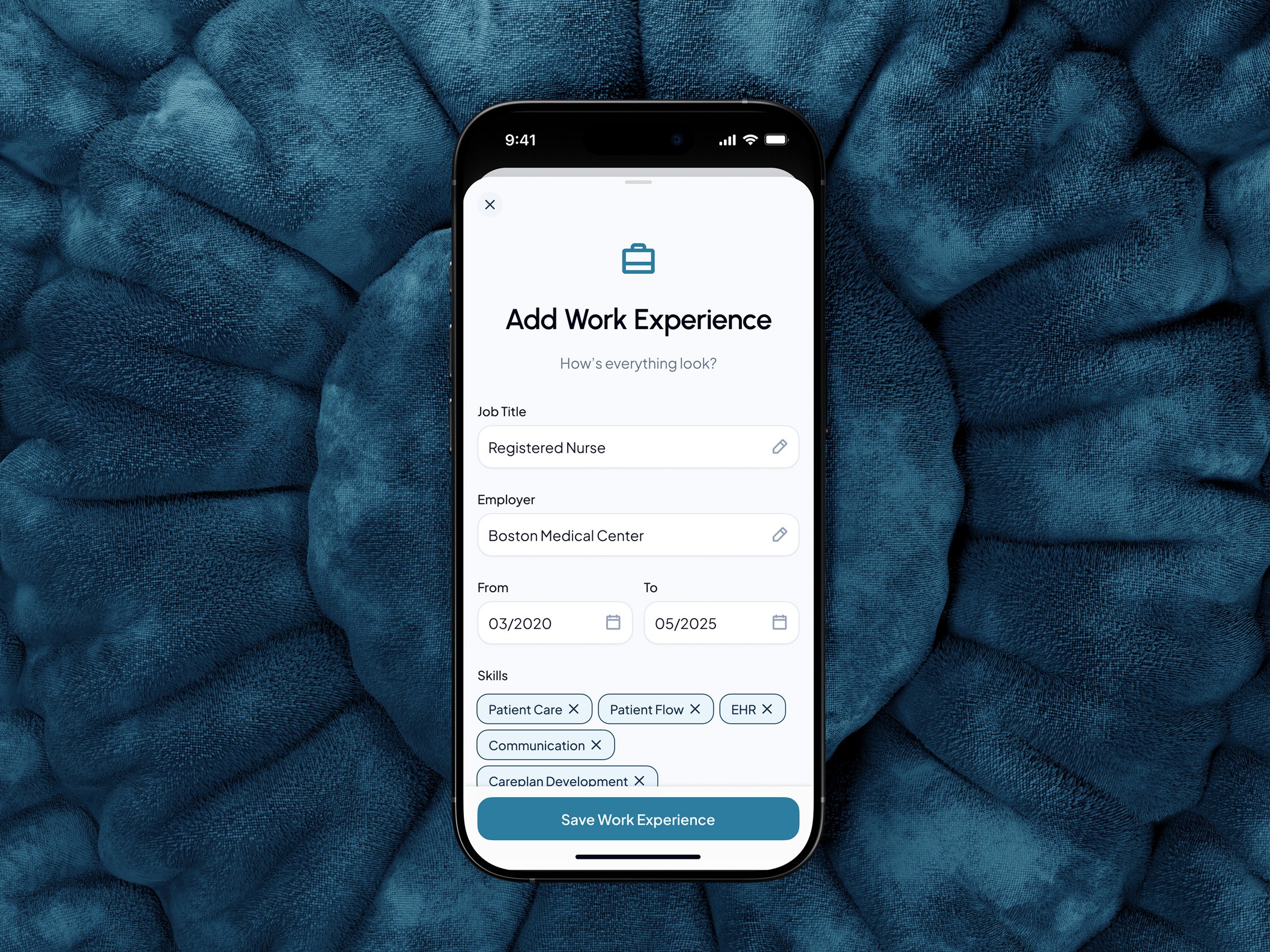
Profile Build → Work Experience Entry
Availability & Payout Setup
Introduced explicit system-controlled fields (certifications, verified roles) versus user-entered fields (experience, skills) to prevent credential abuse.
Designed review states including:
Pending verification
Approved with restrictions
Rejected with required actions
Tested progressive disclosure patterns so caregivers only saw advanced setup steps after verification milestones were met.
Validated with internal stakeholders that separating verification first, profile second reduced confusion and false expectations.
Hi-Fi Interactive Prototypes:
Applied CareLoop’s calm, trust-forward visual language to reinforce legitimacy and safety.
Used neutral tones and subtle status indicators to reduce anxiety during document review and approval waiting periods.
Introduced real-time progress feedback and reassurance messaging to prevent abandonment during longer verification steps.
Simulated realistic caregiver data including mixed certifications, partial approvals, and role limitations.
Added microcopy and system feedback to clarify why certain roles or tasks were unavailable prior to approval.
Design System Development:
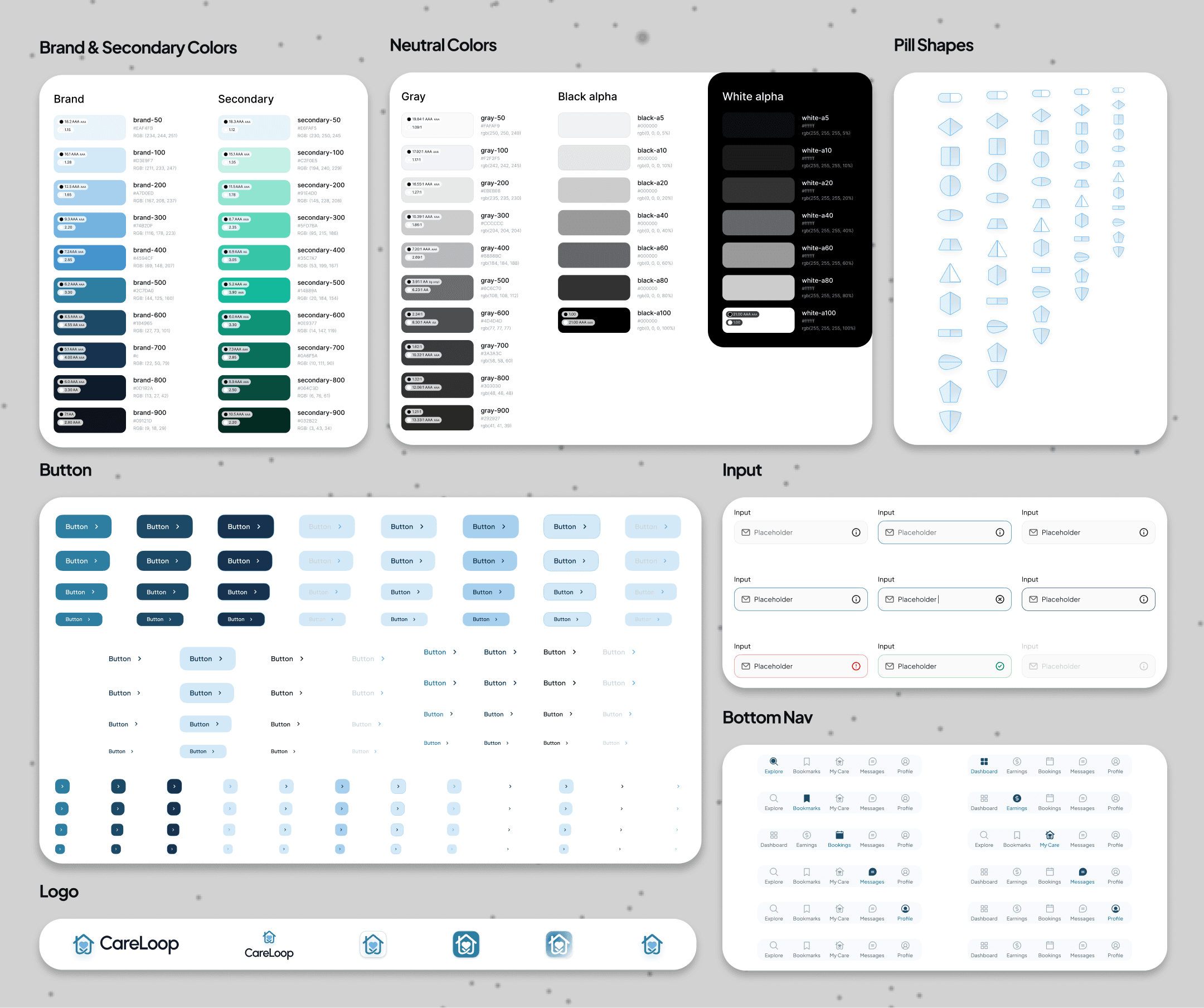
Extended the CareLoop design system to support compliance-driven flows without breaking consistency.
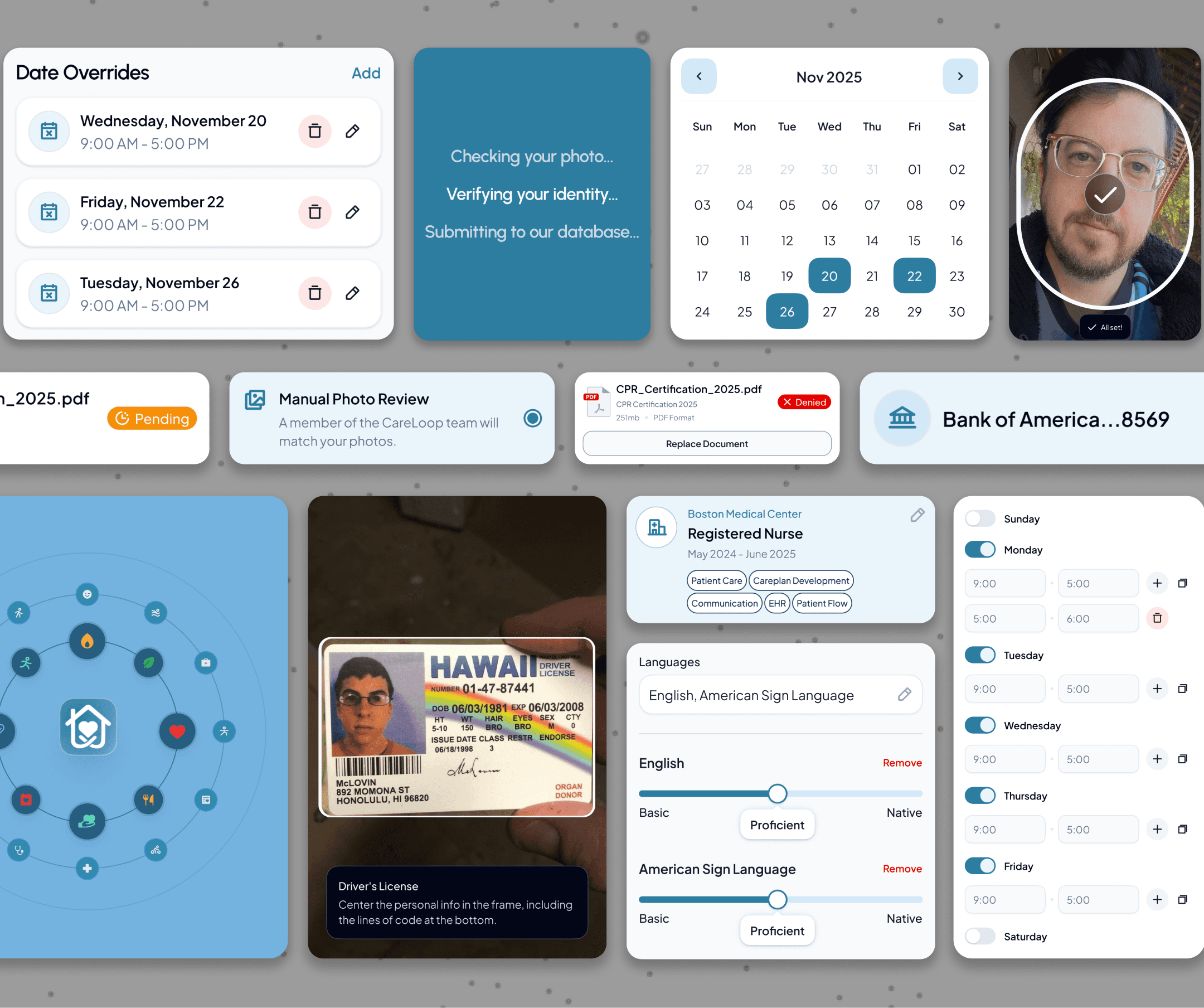
Core components included:
Stepper-based onboarding modules
Verification status banners
Document upload cards
System-locked vs user-editable fields
Admin review tables and status badges
Defined reusable patterns for approval states, error handling, and admin feedback loops.
Ensured all components scaled across caregiver onboarding, admin moderation, and future regulatory expansion.
05
Key Features
Clear Role & Credential Separation:
Structured profile architecture that distinctly separates job title, certification, and skills. Job titles tied to verified credentials are system-controlled and locked post-approval, while skills remain user-editable. This prevents misrepresentation while preserving profile flexibility and accuracy.
State-Based Approval System:
A dynamic status framework that supports partial approvals and layered validation. For example, identity may be approved while certifications remain pending. Locked versus editable fields adapt based on verification state, ensuring regulatory integrity while maintaining a smooth onboarding experience.
Fraud Prevention & Safeguards:
Guardrails designed to prevent unverified caregivers from claiming protected roles. Credential-linked job titles cannot be manually entered without approval, and rejected certifications trigger clear remediation pathways rather than silent failure states.
Trust-Centered Transparency:
Clear system messaging communicates what has been verified and what is still under review. This reinforces trust with both caregivers and careseekers, while reducing support burden through proactive clarity.
Verification-Tied Role Controls:
Profile inputs dynamically adapt based on credential status. Work experience entries are constrained by verified certifications, preventing caregivers from selecting protected titles (such as CNA) unless officially approved. Adjacent, non-regulated roles remain available, preserving flexibility without compromising compliance.
Clear Distinction Between Credentials and Skills:
The UI intentionally separates verified certifications from self-reported skills and experience. Credential-backed roles are system-controlled and badge-based, while skills remain editable. This prevents conflation and reinforces transparency for careseekers reviewing profiles.
Resume-Friendly Progress States:
Caregivers can save progress and return at any time, with visible progress indicators showing what is complete, pending, or required. Inline validation and instructional error states guide correction without punitive friction.
Educative Error Handling & Guardrails:
Instead of hard stops, the system explains why certain roles or fields are unavailable. Error states focus on guidance rather than restriction, helping caregivers understand platform standards while maintaining momentum.
Clear Outcome States with Actionable Guidance:
Review decisions are presented with precise explanations and visible status labels such as Approved, Needs Info, or Rejected. When additional documentation is required, caregivers are guided through what needs correction rather than receiving vague or silent denials.
Inline Correction & Re-Upload Flow:
Caregivers can immediately update or re-upload documents directly within the review interface. This reduces friction, prevents restart loops, and maintains onboarding momentum without requiring external support.
Dashboard-Level Status Visibility:
Verification progress and outcomes are surfaced prominently within the caregiver dashboard, ensuring transparency beyond the initial onboarding flow. Real-time notifications reinforce clarity and prevent missed updates.
Human Review Supported by System Rules:
The review process balances structured validation logic with human oversight. System-enforced guardrails prevent credential misuse, while human reviewers handle edge cases and exceptions, avoiding opaque or inconsistent moderation.
Next
In an increasingly distributed workforce, digital nomads and remote professionals struggle to find seamless solutions that blend travel, workspace booking, productivity tools, and community—all in one place. NOMAD+ is a mobile-first platform that unifies hybrid stay booking, coworking access, productivity tracking, and local community features into a single, delightful experience.