CareLoop — Careseeker Marketplace & Matching
CareLoop — Careseeker Marketplace & Matching
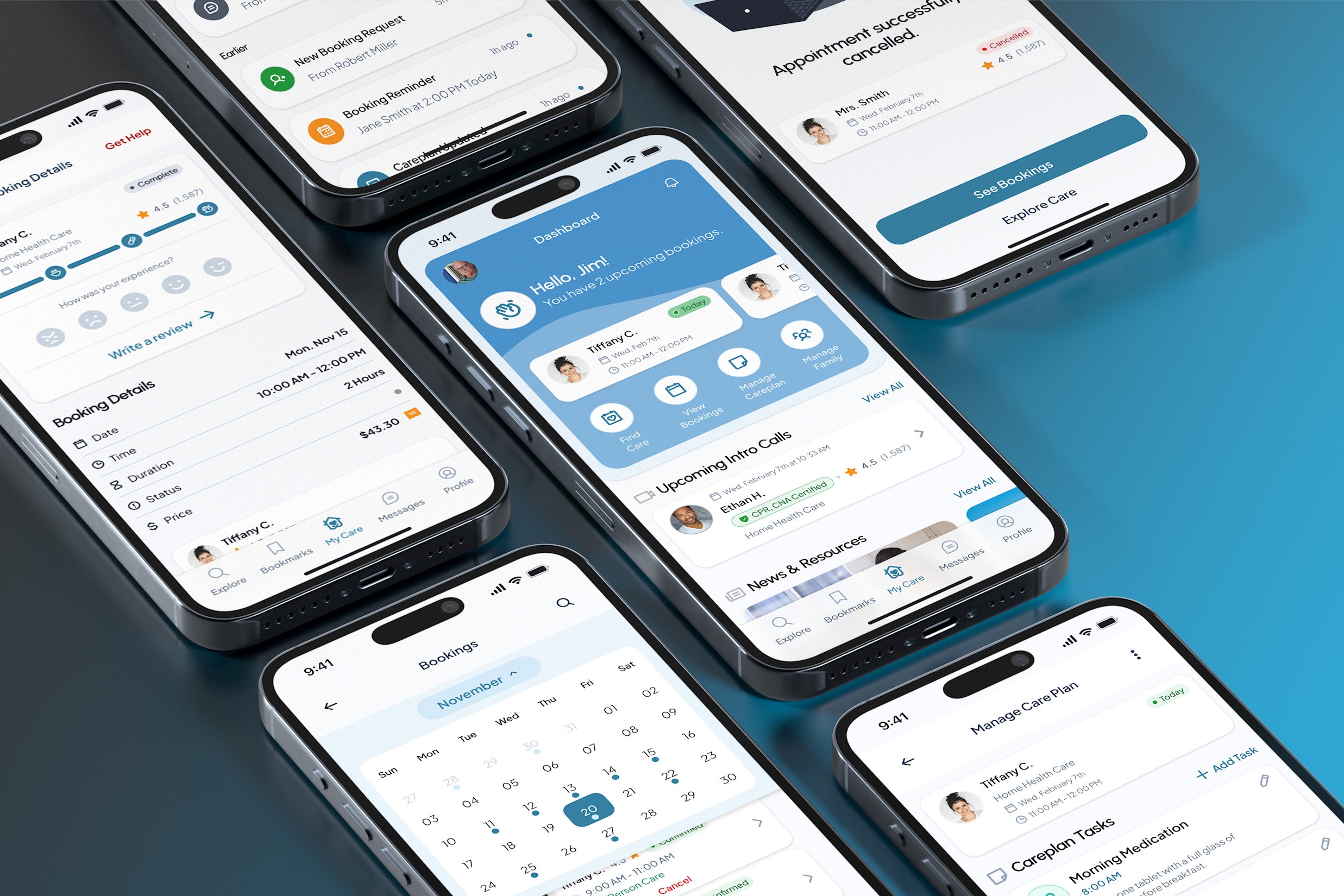
CareLoop is a multi-sided home healthcare platform connecting caregivers, families, and care operations. This case study focuses on the Careseeker Marketplace & Matching experience, designed to help families quickly discover qualified caregivers, compare trust signals, and confidently book care. The solution emphasizes credential visibility, flexible filtering, and streamlined booking pathways to reduce decision friction and improve caregiver selection within a high-trust healthcare environment.
Year
2026
Client
CareLoop
Service
UX/UI Design
Role
Lead UX/UI Designer
01
Project Goals
Create a Trust-First Caregiver Discovery Experience
Objective: Help careseekers quickly identify qualified caregivers by surfacing trust signals during initial browsing.
Success Metric: Increase caregiver profile engagement while reducing time spent comparing unqualified options.
Sub-Goals:
Surface verified credentials directly within caregiver cards.
Highlight certifications, experience, and ratings as primary trust indicators.
Clearly distinguish verified information from self-reported details.
Standardize caregiver card layouts for quick scanning.
Enable Efficient Filtering for High-Stakes Decision Making
Objective: Allow careseekers to narrow results quickly based on care needs, availability, and qualifications.
Success Metric: Decrease time to first meaningful caregiver shortlist.
Sub-Goals:
Introduce multi-select filters for care type, certifications, and specialties.
Allow filtering by availability, schedule, and shift type.
Support location-based filtering for proximity.
Persist filter selections during browsing sessions.
Design Caregiver Cards that Balance Information and Scannability
Objective: Provide enough caregiver detail for confident decision-making without overwhelming users.
Success Metric: Increase caregiver card click-through rate.
Sub-Goals:
Highlight certifications, hourly rate, and years of experience.
Display availability indicators directly on cards.
Include profile photo and short experience summary.
Use consistent visual hierarchy across listings.
Support Shortlisting and Comparison Behavior
Objective: Allow careseekers to save and compare caregivers before booking.
Success Metric: Increase use of bookmarking and shortlist features.
Sub-Goals:
Enable bookmarking directly from caregiver cards.
Create a saved caregivers comparison list.
Provide quick access to saved caregivers from navigation.
Maintain saved state across sessions.
Reduce Booking Friction from Discovery to Action
Objective: Provide operations teams with efficient tools to review, approve, and enforce credential accuracy at scale.
Success Metric: Reduce manual review time per caregiver profile.
Sub-Goals:
Create centralized admin review queues for certification submissions.
Automatically flag suspicious work experience entries.
Enable one-click approval, rejection, and escalation actions.
Maintain audit-friendly records of verification decisions.
Maintain a Low-Friction Onboarding Experience
Objective: Create a seamless path from browsing caregivers to scheduling care.
Success Metric: Increase caregiver booking initiation rate.
Sub-Goals:
Include clear primary booking CTA on caregiver profiles.
Show availability preview before scheduling.
Allow direct transition from shortlist to booking.
Provide reassurance messaging prior to scheduling.
02
Research and Discovery
The design process began with research into how families search for caregivers, evaluate trust signals, and transition from browsing to booking. The goal was to uncover friction in caregiver discovery, reduce decision anxiety, and improve confidence in selecting qualified care.
Competitive Analysis
I evaluated platforms across adjacent categories to identify patterns and gaps in caregiver discovery and matching.
Caregiver Marketplaces:
Most platforms emphasize profile lists but bury critical trust signals such as certifications and verification status.
Filtering is often limited or hidden behind multiple steps.
Booking flows frequently require messaging first, increasing friction for urgent care needs.
General Service Marketplaces:
Platforms like home service apps rely heavily on ratings but lack regulated credential visibility.
Skills and certifications are often mixed, creating confusion around qualifications.
Availability is rarely surfaced early in the decision process.
Key User Types
Families seeking in-home care with varying urgency and care complexity.
Adult children coordinating care for parents remotely.
Individuals requiring short-term or recurring support.
Careseekers prioritizing verified credentials and safety.
User Interviews and Stakeholder Input
Insights were gathered through stakeholder discussions, early concept reviews, and feedback on caregiver browsing flows.
Competitive Patterns Observed
Credential gating used to restrict access to regulated roles
Badge-based systems to visually indicate verified status
Manual review queues for edge cases and escalation
Clear separation between verified credentials and self-reported data
Journey Mapping
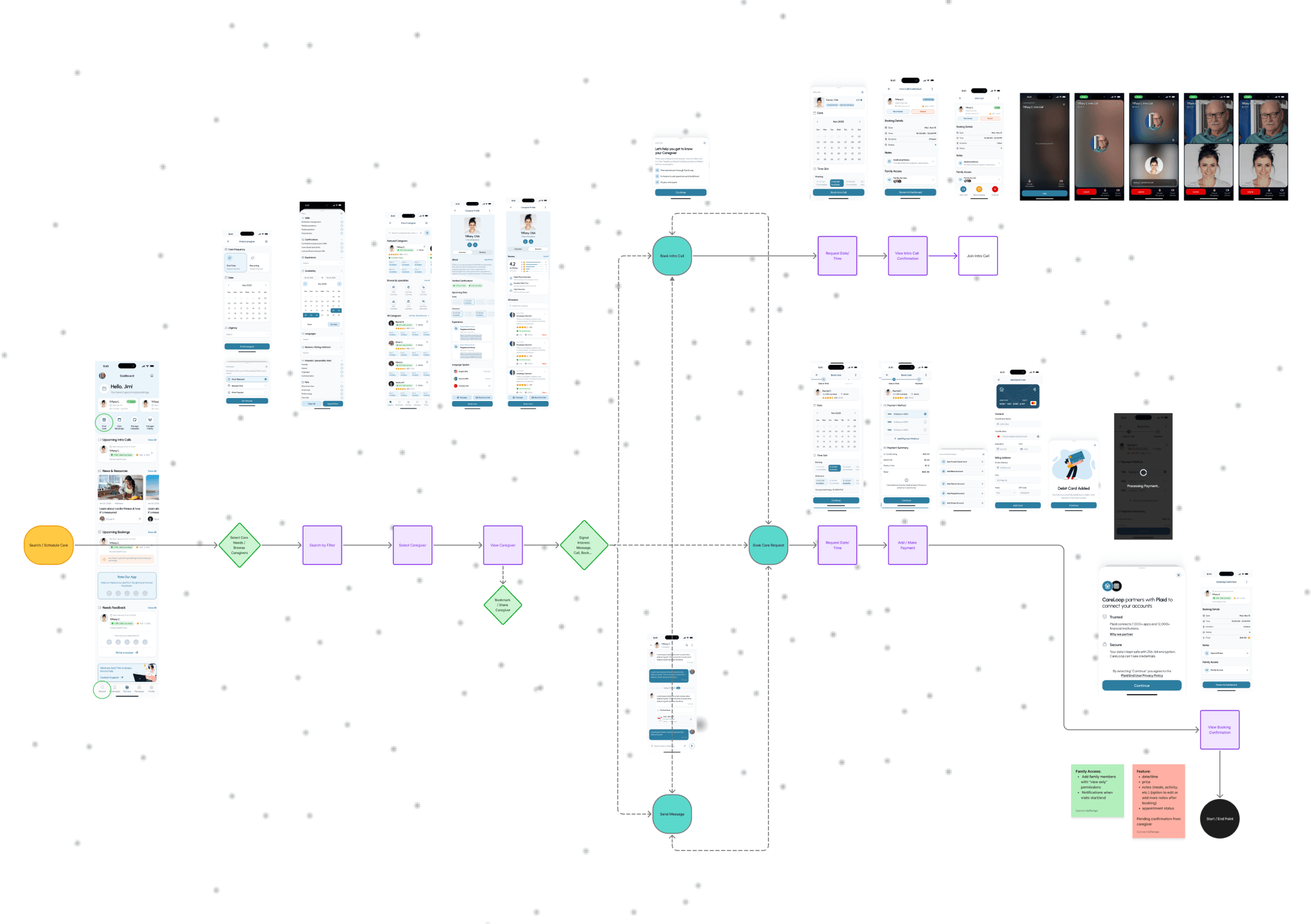
I mapped the end-to-end experience from caregiver discovery through booking initiation.
Key Journeys Included:
Browsing caregivers and scanning trust indicators.
Filtering based on care needs and availability.
Comparing shortlisted caregivers.
Viewing caregiver profiles and initiating booking.
This process surfaced drop-off points primarily during filtering, comparison, and booking initiation, which informed the decision to prioritize trust visibility and streamlined discovery.
03
Key Findings
Trust signals must be immediate:
Families look for certifications and verification before considering other profile details.
Filtering reduces decision anxiety:
Users feel overwhelmed when too many caregivers appear without structured filtering.
Availability is a primary decision driver:
Careseekers want to confirm schedule compatibility early in the process.
Consistency improves confidence:
Standardized caregiver cards help users compare options more efficiently.
04
Wireframing and Prototyping
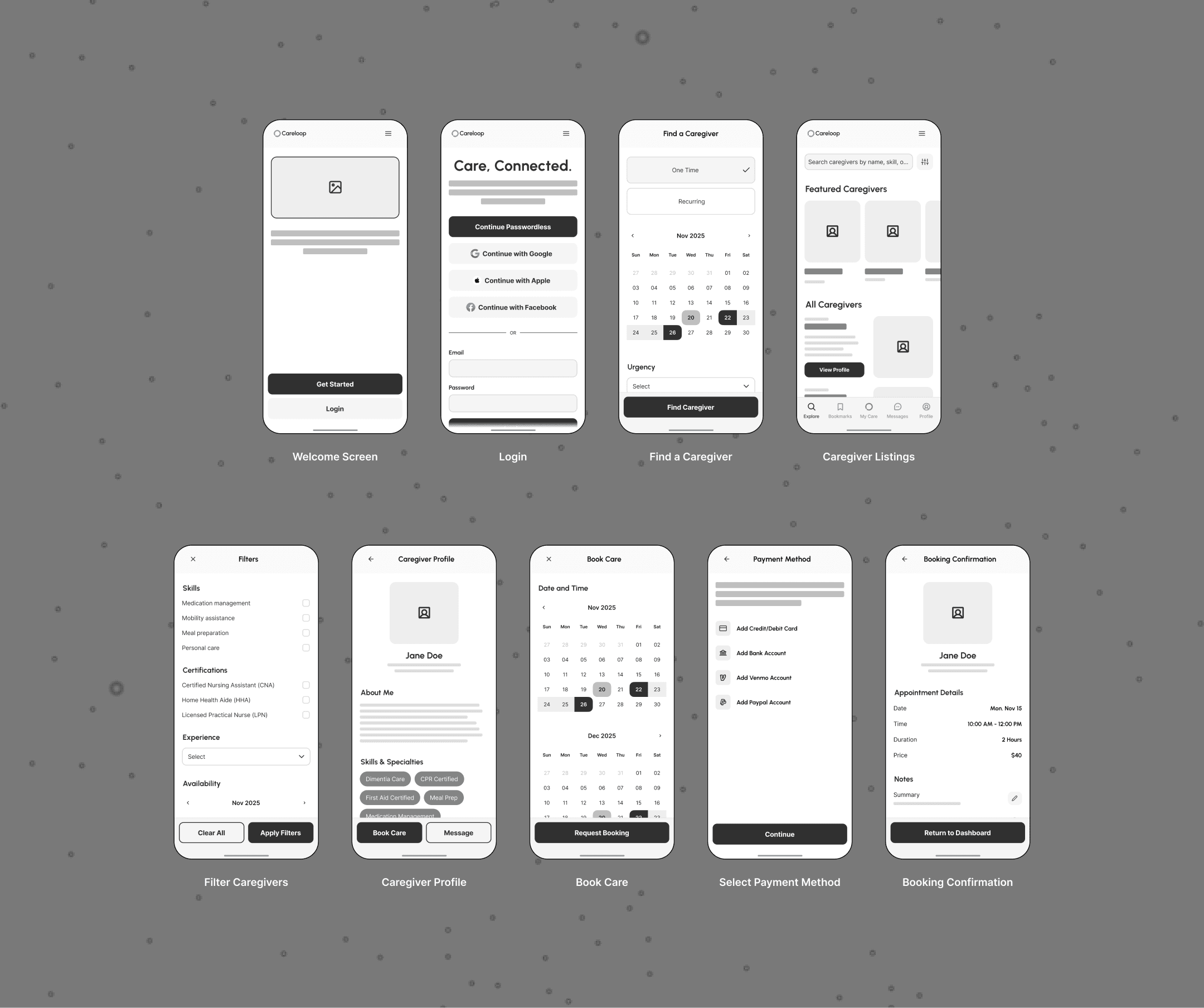
Lo-Fi Sketches (Paper and Figma):
Mapped caregiver discovery journeys including browsing, filtering, comparison, and booking.
Explored caregiver card layouts prioritizing certifications and availability.
Tested filter placement and hierarchy for quick narrowing of results.
Iterated on trust signal prominence within listing views.
Mid-Fi Figma Prototypes:
Built clickable onboarding flows for:
Marketplace Feed → Caregiver Card → Profile View → Booking Initiation
Filter Selection → Refined Results → Shortlist → Profile Comparison
Saved Caregivers → Direct Booking Flow
Tested variations of caregiver cards, badge systems, and availability indicators.
Internal reviews validated that surfacing credentials earlier improved clarity.
Refined filter UI to balance flexibility with simplicity.
Hi-Fi Interactive Prototypes:
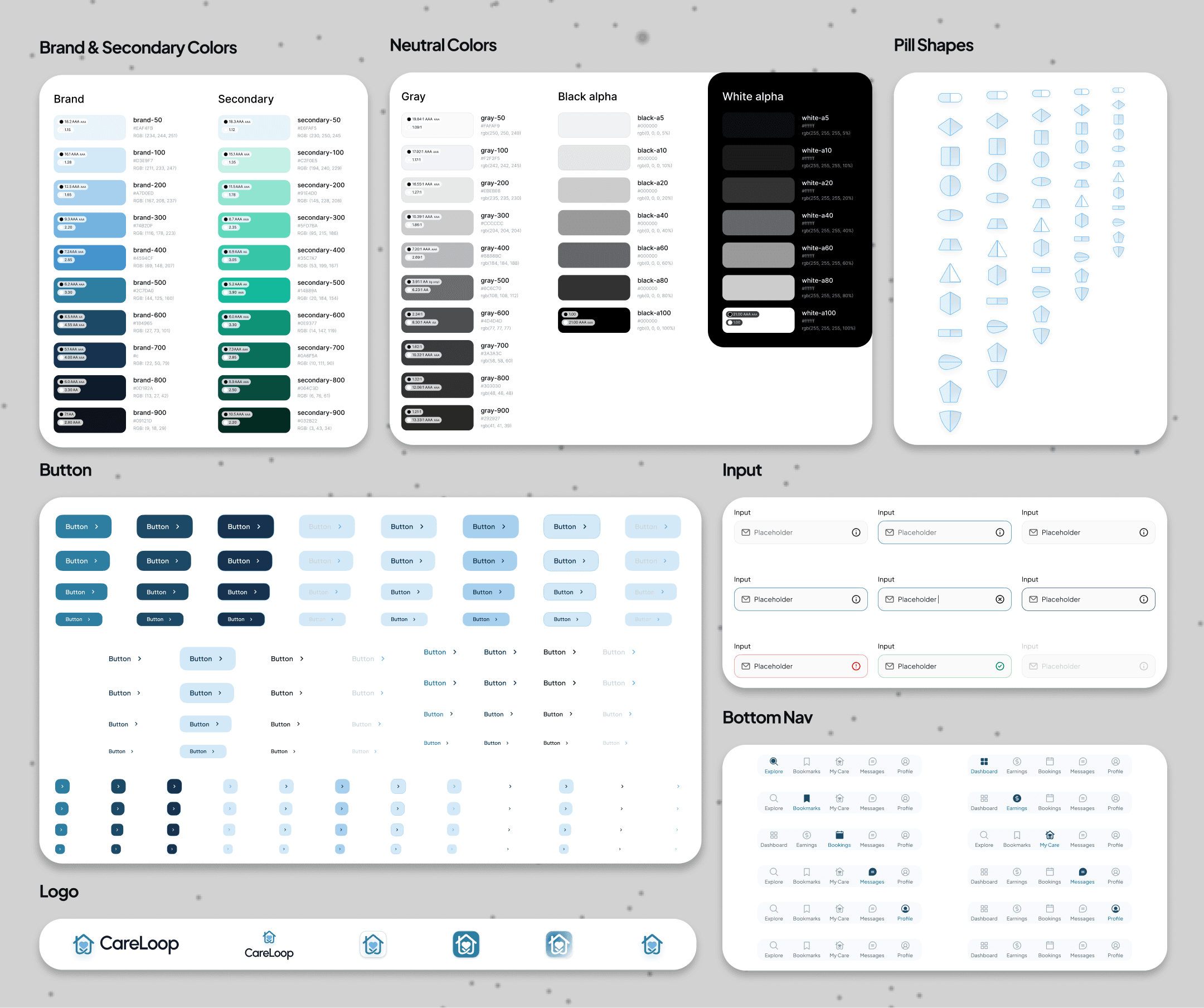
Applied CareLoop brand styling with emphasis on clarity and trust.
Introduced verification badges and credential highlights.
Simulated real caregiver data including certifications, experience, and schedules.
Prototyped interactive filtering and shortlist functionality.
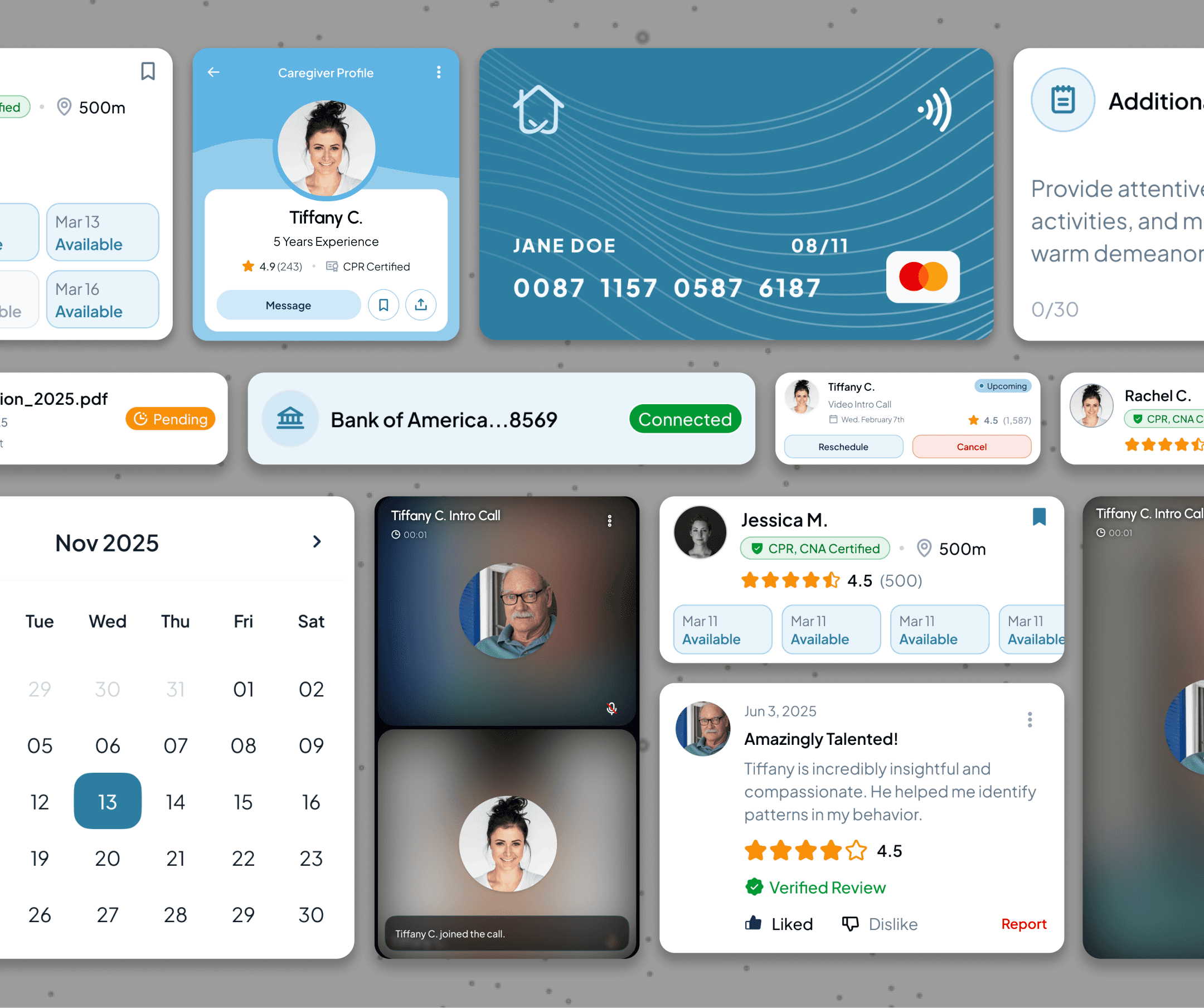
Design System Development:
Extended component library for caregiver discovery and matching.
Core components included:
Caregiver cards
Verification badges
Filter chips
Availability indicators
Shortlist interactions
Defined typography hierarchy for listing readability.
Created badge styles for verification and credentials.
Ensured reusable components across marketplace and profile flows.
05
Key Features
Verification-First Caregiver Cards:
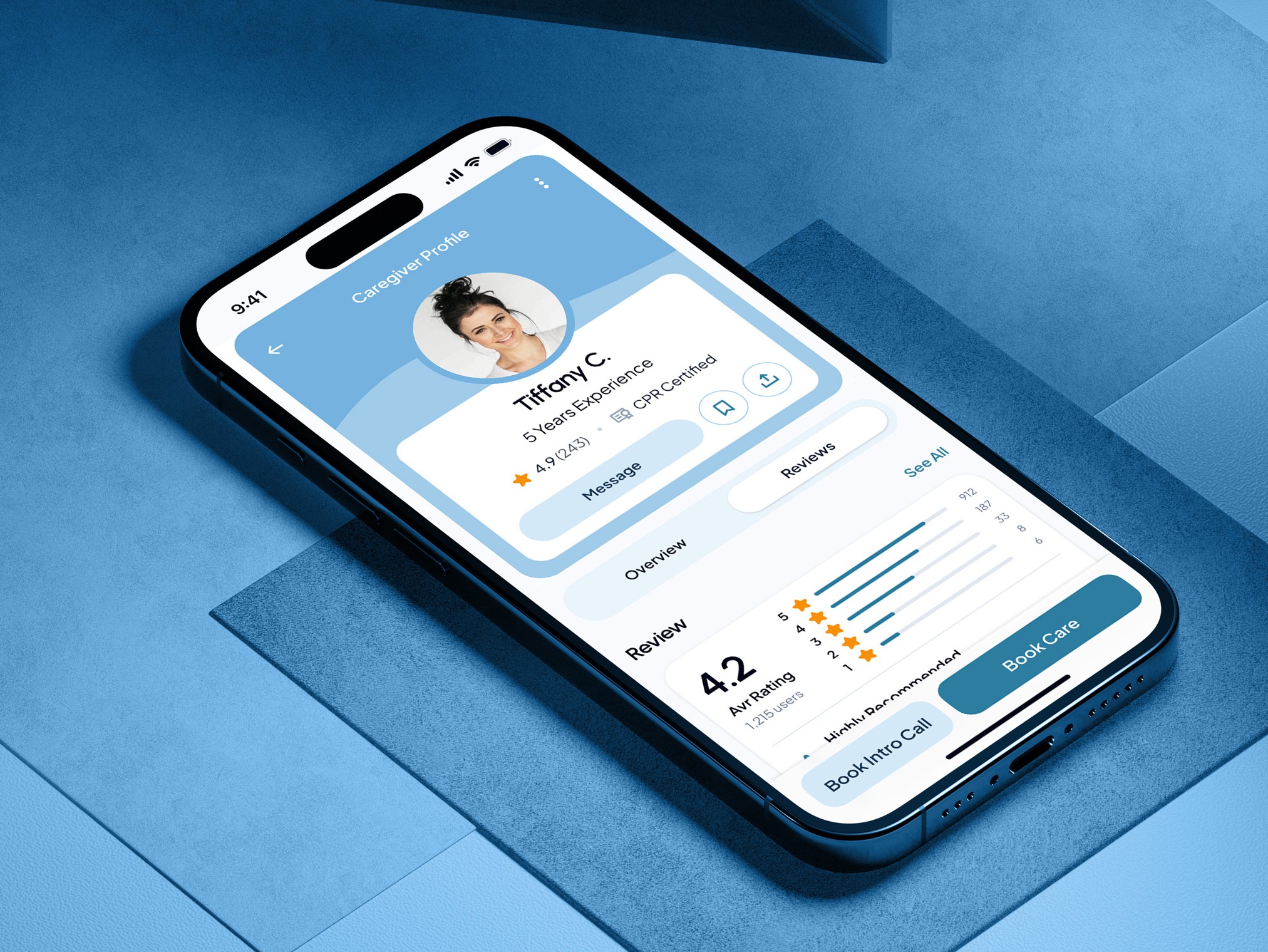
Caregiver listings surface verified credentials, certifications, and identity badges directly within each card. Trust signals are prioritized in the visual hierarchy, allowing careseekers to quickly assess qualifications without opening individual profiles. This reduces uncertainty and improves confidence during initial browsing.
Structured Filtering & Matching:
A flexible filtering system allows careseekers to narrow caregivers by care type, certifications, availability, and specialties. Multi-select filters help users quickly refine results based on specific care needs while maintaining browsing context.
Availability-Driven Discovery:
Real-time availability indicators are displayed directly on caregiver cards, allowing careseekers to prioritize caregivers who match schedule requirements. Early visibility into timing compatibility reduces friction and accelerates booking decisions.
Consistent Card-Based Comparison:
Standardized caregiver cards maintain consistent layout and information hierarchy across listings. This enables quick side-by-side comparison and reduces cognitive load when evaluating multiple caregivers.
Guided Intro Call Entry Point:
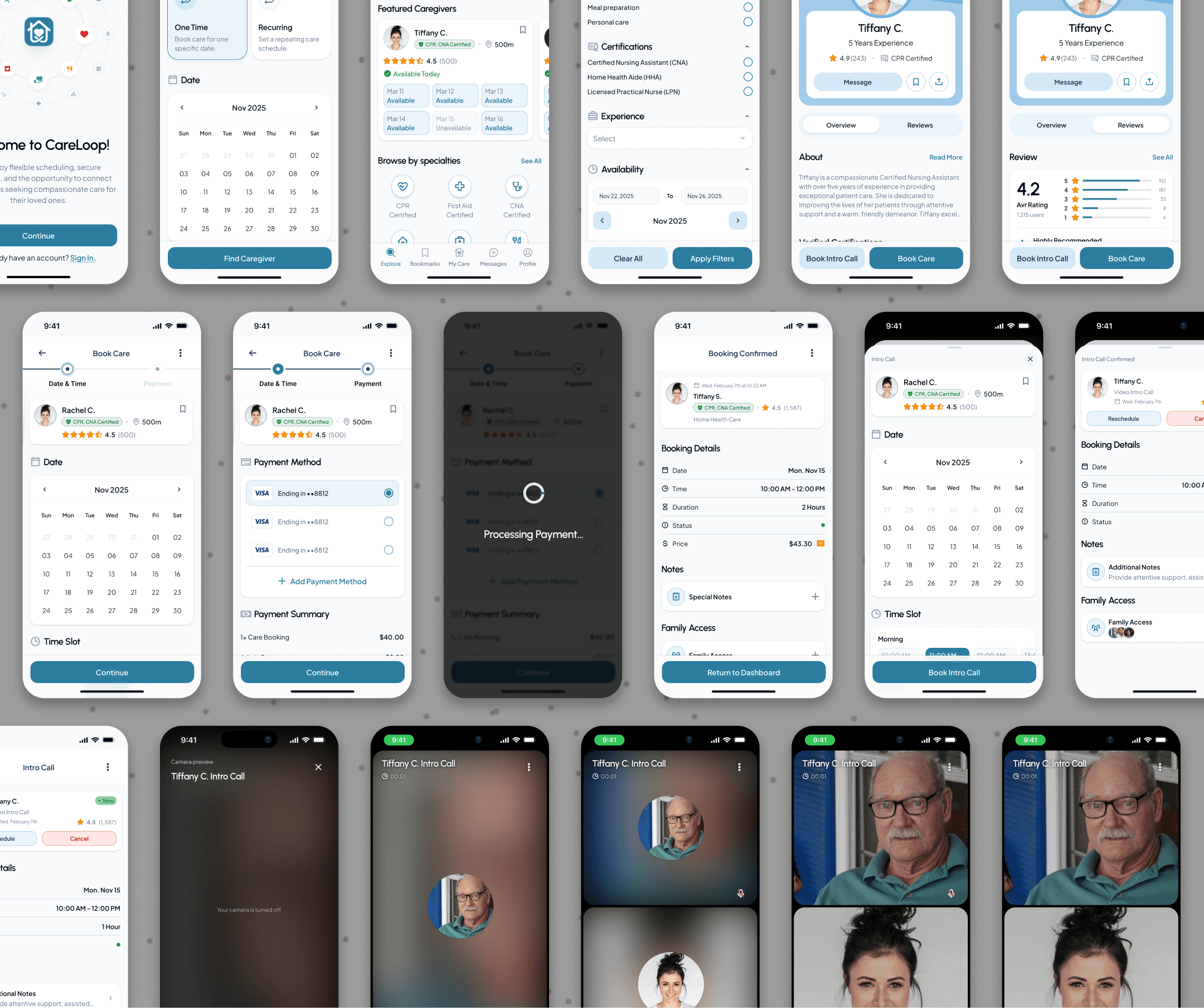
A clearly surfaced “Join Intro Call” action that allows careseekers to connect with caregivers before committing to care. This reduces pressure in the decision-making process and creates a low-friction path to initial engagement.
Availability-Based Call Scheduling:
Intro call scheduling is tied directly to caregiver availability, ensuring that users only see realistic time options. This prevents back-and-forth coordination and improves scheduling efficiency.
Trust-Building Pre-Commitment Interaction:
The intro call provides a structured opportunity for families to ask questions, confirm fit, and align on care expectations. This builds confidence before booking and reduces uncertainty.
Clear Next-Step Progression:
After completing the intro call, users are guided toward booking care with contextual next steps. This maintains momentum and supports a smooth transition from conversation to commitment.
Streamlined Care Booking Flow:
A structured booking experience that guides careseekers from caregiver selection to confirmed care. The flow reduces friction by clearly organizing scheduling, care details, and confirmation within a single streamlined process.
Schedule-Based Booking Selection:
Users select care dates and times directly within the booking interface, aligned with caregiver availability. This prevents scheduling conflicts and ensures realistic booking options.
Care Details & Requirements Capture:
The booking flow collects essential care information such as care type, notes, and special requirements. This ensures caregivers receive the context needed before care begins.
Clear Booking Confirmation & Next Steps:
After booking, users receive a confirmation state with care details, schedule summary, and next-step guidance. This reinforces trust and prepares both parties for upcoming care.
Next
CareLoop is a multi-sided home healthcare platform connecting caregivers and families. This case study focuses on the Scheduling & Care Management experience, designed to help families coordinate ongoing care, track visits, and manage care plans while giving caregivers structure and clarity after booking.